Why buyers choose it
- Clear, glossy gels — a premium look in sauces, fillings, desserts and pearls
- Bright white, batch after batch — a clean appearance in the finished product
- Ultrafine and low pulp — smooth texture with minimal specks
- Neutral taste with FSSC 22000 consistency — reliable on the production line
Native Tapioca Starch
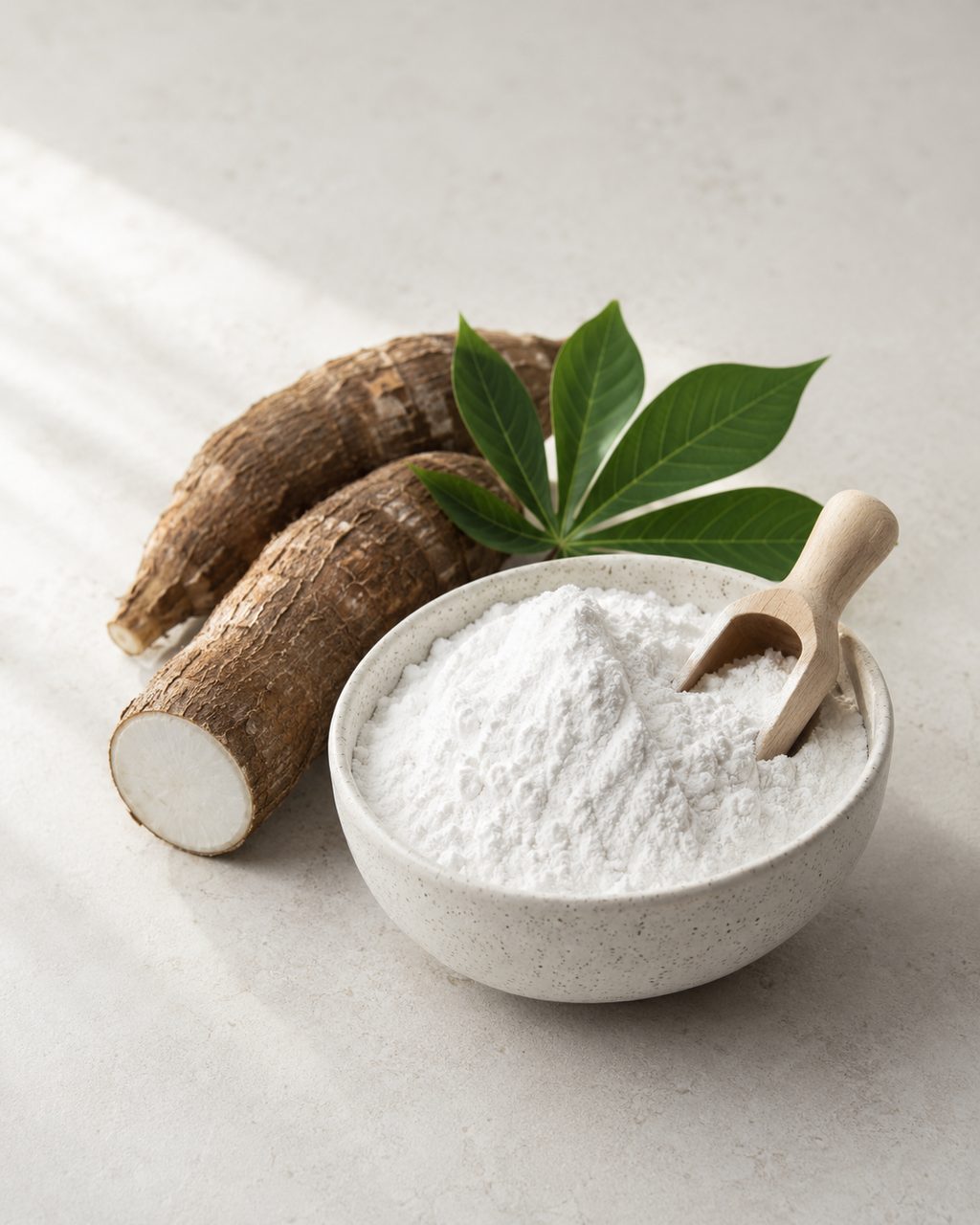
Ultra-fine, bright-white native tapioca starch — low pulp, a clear glossy gel and a neutral taste.
Unmodified tapioca (cassava) starch extracted from fresh roots, retaining its natural neutral taste, clarity, and high paste viscosity. Produced under an FSSC 22000-certified food safety system and offered in food grades (≤10 and ≤30 ppm SO₂) and an industrial grade (≤100 ppm SO₂).
Applications
- Noodles, vermicelli & rice products
- Sauces, soups & gravies
- Snacks & extruded foods
- Bakery & confectionery
- Paper, textile & adhesive (industrial)
Specifications & quality assurance
Guaranteed specification limits — every lot is tested before release, and a lot-specific Certificate of Analysis (COA) accompanies each shipment.
| Parameter | Unit | Value | Analysis method |
|---|---|---|---|
| Moisture | % | 13.0 max | Moisture Balance |
| Starch content | % | 85 min | Calculation |
| Whiteness (Kett) | % | 90 min | Kett C130 |
| pH | — | 5 – 7 | pH Meter |
| Viscosity (6% soln, peak) | BU | 650 min | Brabender Viscograph E |
| Ash | % | 0.2 max | AOAC |
| Pulp | cc/50 g | 0.2 max | Sieve Test (106 micron) |
| Fineness (pass 150 µm) | % | 99 min | Sieve Test (150 micron) |
Published grades — SO₂ grades
- SO₂ ≤ 10 ppm Food grade
- SO₂ ≤ 30 ppm Food grade
- SO₂ ≤ 100 ppm Industrial grade
Packaging
30 kg bags; 500 kg and 850 kg jumbo bags (FIBC). Custom packaging on request.
With every shipment
- Certificate of Analysis (CoA) for the lot
- Starch milled to your agreed specification
- Produced under FSSC 22000 — audited by SGS
Related guides
Native vs Modified Tapioca Starch: What's the Difference?
Native starch is the unmodified root extract; modified starch is chemically or physically altered for specific performance. Here's how to choose.
5min readSO₂ Grades in Tapioca Starch: How to Specify ≤10, ≤30 and ≤100 ppm
SO₂ residual separates food grades (≤10 and ≤30 ppm) from industrial grade (≤100 ppm). Here's what each level means and how to choose.
4min readWhat a Tapioca Starch COA Should Include
A complete COA tells you moisture, starch content, whiteness, pH, viscosity, ash, SO₂, and microbiology. Here's how to read one.
5min readReady to source premium tapioca starch?
Send us your product, destination, and volume — we will respond with a tailored quotation.
Led by Praphon Sinsadok, Deputy Secretary General, Thai Tapioca Starch Association (TTSA) · we typically reply within 1–2 business days.